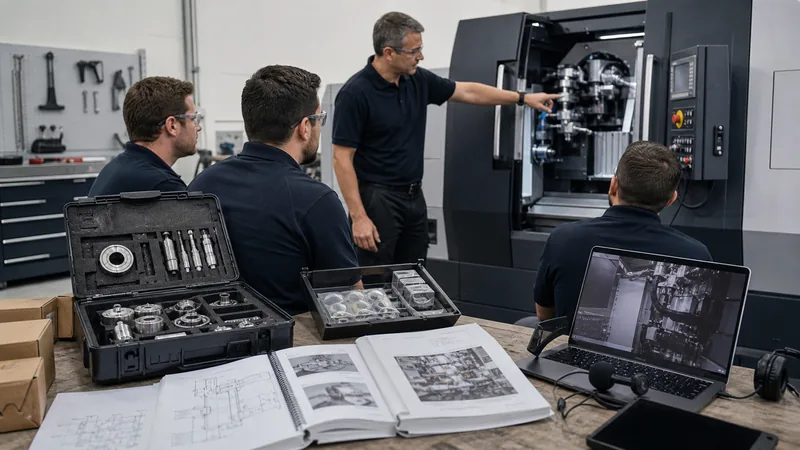
Quick answer: Spare parts, documentation, and training should be contract deliverables for imported industrial equipment. Buyers need enough information and capability to operate, maintain, recover, and support the accepted machine after the supplier’s build team leaves.
A generic manual and one box of spares are not a support plan. Define the equipment hierarchy, critical parts, wear items, lead-time risk, drawings, software, backups, training roles, language, and update process before shipment.
Review YISEN’s related equipment category, custom automation service process, and manufacturing overview before requesting a project-specific proposal.
Imported equipment support deliverables
| Decision factor | Buyer question | Evidence to request |
|---|---|---|
| Parts strategy | Which wear, critical, long-lead, consumable, and recommended parts are included? | Prioritized parts list with quantities and identifiers |
| Drawings | Are final mechanical, electrical, pneumatic, hydraulic, and layout documents delivered? | As-built document register |
| Software | Are PLC, HMI, robot, drive, vision, recipe, and computer backups included? | Restorable accepted-version archive |
| Manuals | Do instructions cover operation, setup, faults, cleaning, maintenance, safety, and replacement? | Machine-specific manuals |
| Training | Are operators, maintenance, controls, safety, and supervisors trained for their tasks? | Role-based agenda and competency check |
| Support | How are issues logged, escalated, diagnosed, and closed across time zones? | Service and remote-access procedure |
A practical procurement process
- Build a criticality-based parts list. Classify parts by failure impact, wear, availability, lead time, substitution difficulty, and storage life. Confirm manufacturer and machine-specific identifiers.
- Collect as-built information. Update drawings and bills of material after FAT changes. Store controlled electronic copies plus any required local hard copies.
- Verify backups and restoration. Do not only receive files; confirm version, tools, licenses, passwords delivered under the contract, and a documented restoration method.
- Train by role and task. Operators need normal use and recovery; maintenance needs isolation and replacement; controls staff need backups and diagnostics; supervisors need escalation and change control.
Common purchasing mistakes to avoid
- Buying only common wear parts. A low-cost uncommon sensor, drive, controller, or custom fixture may create a longer outage.
- Accepting preliminary drawings as final. Build changes and punch-list corrections should be incorporated into the as-built set.
- Treating attendance as competency. Use practical demonstrations and task checks for the people who will own the equipment.
Practical buying scenario
A U.S. plant with limited overnight overlap with an overseas supplier may keep a controlled backup, critical starter spares, clear alarm guidance, and trained local controls staff. Remote support then supplements local recovery instead of replacing it.
Buyer FAQ
How many years of spare parts should be purchased?
Base quantities on criticality, failure likelihood, lead time, stocking cost, operating schedule, and local availability rather than a universal period.
Should source code be included?
Software rights and deliverables are contractual. Define source, compiled files, backups, licenses, reusable modules, passwords, and modification rights before order.
What language should manuals use?
Specify the working language and required translations, then review sample documents before final acceptance.
Can all training be remote?
Remote sessions can support theory and diagnostics, but hands-on operation, maintenance, safety, and recovery may require in-person practice.
How should obsolete components be handled?
Require notice where practical, maintain a current bill of material, review supported alternatives, preserve backups, and plan controlled migration.
Prepare a useful RFQ
For a lifecycle-support plan, send the equipment and product type, materials and dimensions, operating environment, maintenance skills, custom systems, expected operating profile, packaging and storage needs, destination country, and required handover date. Confirm all final specifications, compliance responsibilities, commercial terms, and acceptance criteria with the supplier and qualified U.S. specialists.
For a focused spare parts documentation training imported equipment discussion, submit the project details to YISEN. The technical team can review the confirmed application and propose the next engineering step.