
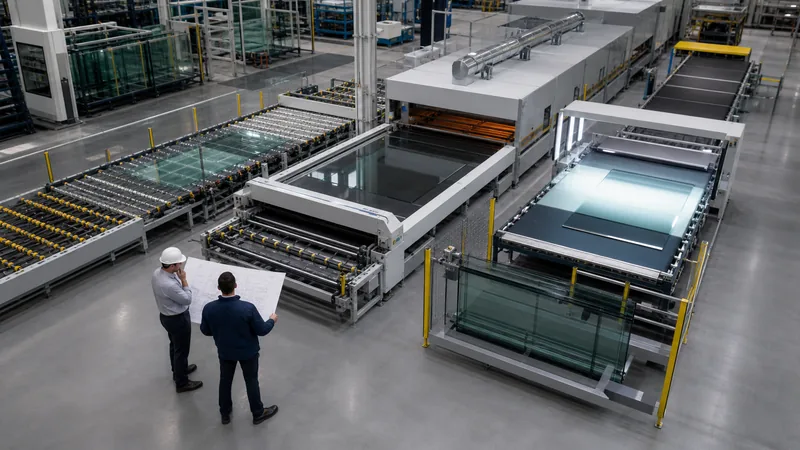
Quick answer: An automatic glass printing line layout should start with product flow, process sequence, safe access, and maintenance—not with fitting machine rectangles into an empty floor plan. The layout must include glass racks, buffers, rejection paths, utilities, guarding, and service clearances.
Provide a scaled building drawing with columns, doors, pits, floor limits, utilities, traffic lanes, and fire or egress constraints. Then map how normal parts, rejected parts, operators, maintenance staff, screens, inks, and spare components move through the area.
Review YISEN’s related equipment category, custom automation service process, and manufacturing overview before requesting a project-specific proposal.
Automatic glass printing line layout inputs
| Decision factor | Buyer question | Evidence to request |
|---|---|---|
| Product flow | Where do raw panels arrive and accepted or rejected panels leave? | Material-flow diagram |
| Process sequence | Which cleaning, printing, drying, cooling, inspection, and buffering steps are required? | Process flow diagram with handoff conditions |
| Building fit | What columns, doors, ceiling heights, floor limits, and traffic routes constrain the line? | Verified scaled site drawing |
| Service access | How are screens, motors, cabinets, filters, and conveyor parts removed? | Maintenance-clearance overlay |
| Safety | Where are guarded zones, doors, emergency access, and operator stations? | Risk-review layout |
| Expansion | Which future products or stations need reserved space and interfaces? | Phased layout option |
A practical procurement process
- Freeze the design basis. List confirmed products, rate assumptions, process times, inspection points, operating shifts, and future scenarios. Mark estimates clearly so they can be revised without being mistaken for requirements.
- Balance and buffer the process. Identify the slowest steps and the effect of short stops. Buffers can protect upstream and downstream equipment, but excessive accumulation can increase glass risk and floor-space demand.
- Run access reviews. Walk through loading, operation, changeover, cleaning, fault recovery, maintenance, and replacement of major components. Use a scaled drawing or digital model to verify reach and travel paths.
- Confirm interfaces. Document who supplies each conveyor handoff, signal, utility drop, foundation item, guard connection, and network connection. Assign one owner to each boundary.
Common purchasing mistakes to avoid
- Using nominal machine footprints. Sales drawings may not show doors, travel, screens, cabinets, or maintenance removal paths.
- Forgetting rejected glass. The line needs a safe method to identify, remove, stage, and document nonconforming panels.
- Placing utilities after design. Late electrical, air, exhaust, and network changes can create rework or unsafe access.
Practical buying scenario
A plant adding printing beside an existing washer and inspection station should verify elevations, transfer speeds, glass orientation, buffer logic, and fault signals at both interfaces. The lowest-risk layout may not be the shortest line if it improves safe access and recovery.
Buyer FAQ
How much extra floor space should be reserved?
There is no universal percentage. Reserve the specific clearances required for people, guards, doors, change parts, screens, maintenance, removal paths, racks, and traffic.
Should the line be straight or U-shaped?
Choose the shape from product flow, building constraints, operator roles, maintenance access, and expansion needs. Either arrangement can work when interfaces are designed correctly.
Where should inspection be located?
Place inspection where defects can be detected before value is added or bad parts reach downstream equipment, while maintaining suitable lighting, access, and handling.
Do I need accumulation buffers?
Use process-time and stoppage data to decide. A buffer should have a defined purpose, capacity, control logic, and safe part-handling method.
What drawing should suppliers provide?
Request a scaled general arrangement, elevations, service zones, guard layout, utility points, anchors or floor loads, operator stations, traffic clearances, and interface details.
Prepare a useful RFQ
For a layout review, send the product type, glass material, size and thickness range, plant environment, scaled floor plan, custom process needs, expected production mix, packaging and rack requirements, destination country, and target installation date. Confirm all final specifications, compliance responsibilities, commercial terms, and acceptance criteria with the supplier and qualified U.S. specialists.
For a focused automatic glass printing line layout discussion, submit the project details to YISEN. The technical team can review the confirmed application and propose the next engineering step.