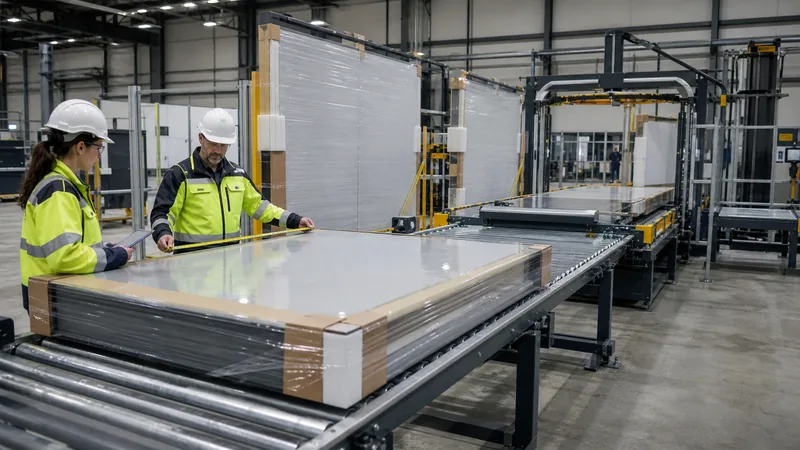
Quick answer: Packaging automation for bulky products should be selected around the product’s size, weight, stability, surface sensitivity, variability, required protection, shipping mode, and safe handling—not around carton rate alone.
Start with actual products and current damage or labor data. Separate operations that are stable and repeatable from tasks that still require judgment, then decide where conveying, protection, wrapping, strapping, labeling, palletizing, or assisted handling creates value.
Review YISEN’s related equipment category, custom automation service process, and manufacturing overview before requesting a project-specific proposal.
Packaging automation for bulky products: buying criteria
| Decision factor | Buyer question | Evidence to request |
|---|---|---|
| Product envelope | What size, weight, center of gravity, stiffness, and surface variation must be handled? | Representative-product matrix |
| Protection | Which edges, faces, corners, moisture, vibration, or abrasion risks matter? | Damage modes and packaging specification |
| Package materials | Which wraps, pads, cartons, crates, straps, or pallets are approved? | Material samples and supplier data |
| Flow and takt | What are the product mix, batch pattern, and peak conditions? | Observed time study and demand profile |
| Handling | Where can clamps, belts, rollers, vacuum, or lifting devices contact? | Contact and lifting plan |
| Shipment | How will packages be stored, loaded, transported, and opened? | Distribution-path review |
A practical procurement process
- Document the damage chain. Record where scratches, corner damage, movement, moisture, or labeling errors occur from production through customer receipt. Improve the packaging specification before automating an unclear process.
- Choose the automation boundary. Automate stable, repetitive tasks and retain judgment where product variation is not yet controlled. Add fixtures, sensing, or error-proofing when the risk justifies it.
- Test package and machine together. Run representative products and approved materials through the complete sequence. Inspect package integrity, product condition, labels, load stability, and safe recovery.
- Plan material replenishment. Review roll or strap changes, corner-protector supply, consumable storage, waste removal, alarms, and ergonomic access. Frequent replenishment can limit real output.
Common purchasing mistakes to avoid
- Designing from an average product. The largest, smallest, heaviest, least stable, and most delicate items often define different constraints.
- Automating before packaging is validated. A machine cannot correct an unsuitable protective design or inconsistent material.
- Ignoring unpacking at the customer. Packaging should protect the product while remaining identifiable and practical to open safely.
Practical buying scenario
A producer of large panels may combine powered conveying, automatic wrapping, corner protection, and assisted pallet transfer while retaining a manual quality check. The optimal boundary depends on product variation and damage risk, not a generic “fully automatic” label.
Buyer FAQ
Can one line handle a wide product range?
Potentially, but confirm the working envelope, locating, support, recipes, consumables, change parts, and transition between representative products.
How is ROI calculated?
Use verified labor, damage, material, output, downtime, maintenance, floor space, utilities, and project costs. Test sensitivity rather than relying on one forecast.
Should packaging materials be sourced locally?
Compare availability, consistency, specifications, cost, storage, and machine compatibility. Qualify alternatives before production use.
What safety information is needed?
Define product handling hazards, guarding, energy isolation, lifting, manual tasks, access, jam recovery, and site standards early.
What should be tested at FAT?
Test representative products and materials, normal and fault modes, changeover, package quality, recovery, safety functions, alarms, and documents.
Prepare a useful RFQ
For a packaging automation review, send the product type, material, dimensions and weight range, handling environment, protection and customization requirements, expected quantities and mix, packaging materials, destination country, and target delivery date. Confirm all final specifications, compliance responsibilities, commercial terms, and acceptance criteria with the supplier and qualified U.S. specialists.
For a focused packaging automation for bulky products discussion, submit the project details to YISEN. The technical team can review the confirmed application and propose the next engineering step.