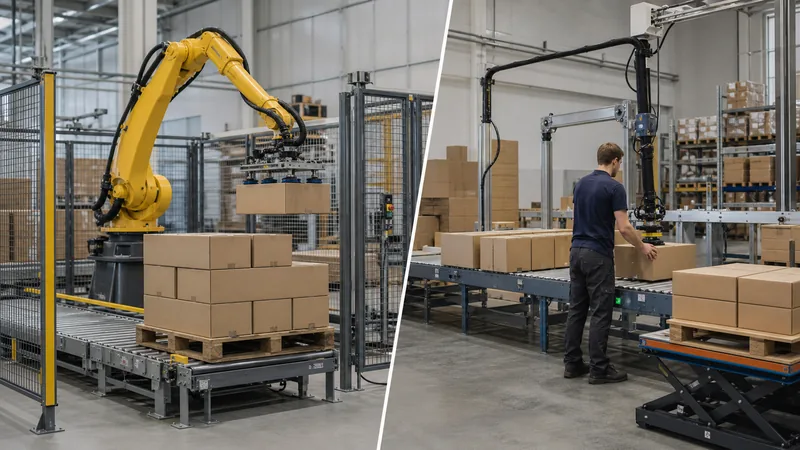
Quick answer: Robotic palletizing and conventional handling should be compared using the actual product mix, pallet patterns, rate, ergonomics, safety, floor space, changeover, uptime, maintenance skills, and lifecycle cost.
A robot can provide flexible motion, but the complete cell also needs infeed control, end-of-arm tooling, pallet handling, guarding, pattern management, and recovery. Assisted manual or conventional automation may remain practical for low-volume or highly variable work.
Review YISEN’s related equipment category, custom automation service process, and manufacturing overview before requesting a project-specific proposal.
Robotic palletizing vs conventional handling criteria
| Decision factor | Buyer question | Evidence to request |
|---|---|---|
| Product and payload | What weights, dimensions, stiffness, and surfaces are handled? | Product matrix and grip trials |
| Pattern and mix | How many pallet patterns, layer rules, labels, and transitions exist? | Approved pattern library |
| Rate | What sustained infeed and pallet exchange sequence is required? | Complete-cell timing model |
| Ergonomics | Which lifts, reaches, rotations, and repetitive tasks are reduced? | Task observation and risk review |
| Safety | How are robot motion, access, pallets, and recovery controlled? | Cell risk assessment and validation plan |
| Support | Can local staff maintain robot, tooling, conveyors, and controls? | Training, spares, and escalation plan |

A practical procurement process
- Measure the current task. Record product arrivals, pattern changes, pallet supply, interruptions, manual touches, injuries or near misses where available, and labor across a full operating pattern.
- Prove the grip and load. Test representative cartons or products, including weak, slippery, deformed, or difficult items. Confirm product condition and load stability after repeated handling.
- Model the complete cell. Include infeed spacing, orientation, pallet exchange, slip sheets, labels, rejects, fencing, operator access, and recovery. Robot cycle time alone is not cell output.
- Plan fallback and recovery. Define safe response to missing products, grip failure, blocked conveyors, incomplete pallets, tool faults, and restart. Identify when manual intervention is allowed.
Common purchasing mistakes to avoid
- Selecting a robot by payload alone. Reach, wrist load, inertia, tooling, acceleration, pattern geometry, and duty affect suitability.
- Underestimating product variation. Flexible programming cannot compensate for ungrippable or unstable products without suitable tooling and presentation.
- Leaving pallet quality undefined. Damaged or inconsistent pallets can affect detection, positioning, and load stability.
Practical buying scenario
A distributor with stable cartons and repeatable pallet patterns may justify a guarded robotic cell. A low-volume operation with frequent exceptions may benefit more from ergonomic lift assistance and improved flow until product data supports further automation.
Current U.S. and technical references
Requirements can change and depend on the final application. Review current official guidance and obtain qualified advice where needed.
Buyer FAQ
Is robotic palletizing always faster?
No. Output depends on the full cell, product arrival, patterns, pallet exchange, tooling, faults, and operational discipline.
Can one tool handle all products?
Sometimes, but verify grip method, product condition, payload, changeover, and failure detection for the full product range.
Do collaborative robots eliminate guarding?
No. The complete application requires a risk assessment; product, tooling, speed, force, access, and surrounding equipment all matter.
What maintenance skills are needed?
Plan for mechanical, electrical, controls, robot programming, tooling, sensors, safety systems, backups, and preventive maintenance.
How should the alternatives be priced?
Compare complete installed scope, labor, damage, consumables, utilities, maintenance, spares, downtime, floor space, training, and expected life.
Prepare a useful RFQ
For a palletizing comparison, send the product and package type, material, dimensions and weight, work environment, pallet patterns, customization needs, expected quantities and mix, packaging requirements, destination country, and required startup date. Confirm all final specifications, compliance responsibilities, commercial terms, and acceptance criteria with the supplier and qualified U.S. specialists.
For a focused robotic palletizing vs conventional handling discussion, submit the project details to YISEN. The technical team can review the confirmed application and propose the next engineering step.