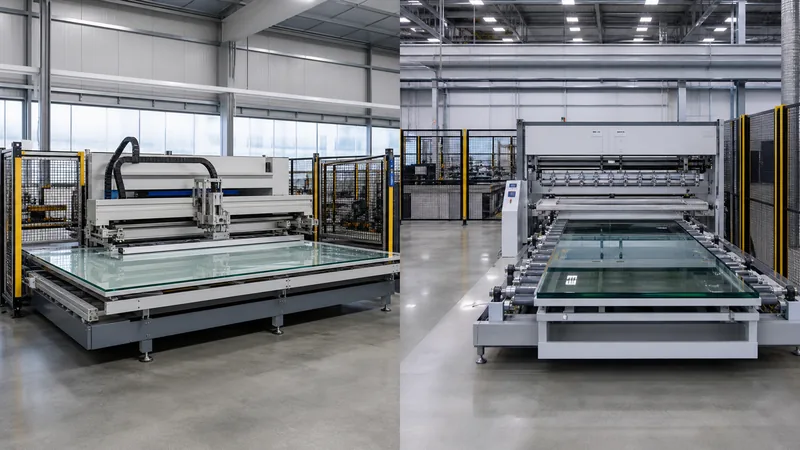
Quick answer: A flatbed and a shuttle glass screen printing machine can use similar printing principles, but their material flow, operator interaction, footprint, and automation options differ. The better layout is the one that fits the buyer’s product mix and upstream/downstream process.
Treat the comparison as a cell-layout decision rather than a label. Suppliers may use the same terms for different mechanisms, so drawings, motion sequences, and sample trials are more reliable than category names.
Review YISEN’s related equipment category, custom automation service process, and manufacturing overview before requesting a project-specific proposal.
Flatbed vs. shuttle glass screen printing machine factors
| Decision factor | Buyer question | Evidence to request |
|---|---|---|
| Material flow | Does glass stay on one table or move between loading and printing positions? | Cycle diagram and operating video using similar parts |
| Operator access | Where are loading, screen change, cleaning, and inspection performed? | Access drawing with guarded and service zones |
| Takt balance | Can loading or unloading overlap with printing? | Timed sequence showing included handling steps |
| Footprint | How much room is needed for motion, guards, doors, and maintenance? | Scaled layout and service-clearance dimensions |
| Changeover | Which stops, recipes, screens, fixtures, and guides must change? | Observed changeover with a defined start and finish |
| Automation path | Can the machine connect to conveyors, dryers, vision, or robots? | Interface list and control responsibility matrix |
A practical procurement process
- Map every movement. Draw how glass enters, locates, prints, exits, and reaches inspection or curing. Include rejected parts and manual recovery, not only the normal automatic sequence.
- Time the complete cycle. Measure from one acceptable part to the next and include loading, alignment, printing, unloading, and operator actions. Ask for separate estimates when processes are not yet proven.
- Check access and ergonomics. Review reach distances, screen handling, cleaning points, guard doors, and lifting aids. Frequent tasks should not require unsafe reaches or removal of permanent safeguards.
- Test the hardest changeover. Use the two products with the greatest difference in size or artwork. Record adjustment points, tools, recipe changes, first-piece inspection, and the time to resume acceptable production.
Common purchasing mistakes to avoid
- Assuming shuttle always means faster. Overlap can reduce idle time, but real output depends on the slowest process and the full handling sequence.
- Ignoring maintenance travel. A compact sales layout may omit door swing, table travel, screen removal, and service access.
- Comparing prices before scopes. One proposal may include guarding, alignment, conveyors, and controls that another lists as options.
Practical buying scenario
A plant with frequent short runs may value quick access and predictable changeover more than overlapping motion. A high-volume line with stable products may benefit more from separated loading and printing positions if the surrounding process can keep pace.
Buyer FAQ
Is a shuttle machine always more automated?
No. Shuttle motion describes part or table movement, not the complete automation level. Loading, alignment, screen handling, inspection, and outfeed may still be manual.
Which design uses less floor space?
That depends on travel direction, guarding, operator stations, and service clearances. Compare scaled layouts using the same building constraints.
Which design is easier to clean?
Ask the supplier to demonstrate screen access, ink recovery, table cleaning, and spill containment. Ease of cleaning depends on the detailed design.
Can either type handle multiple glass sizes?
Potentially, but range alone is not enough. Confirm locating, support, contact points, recipes, tooling, and changeover evidence for representative sizes.
How should output be compared?
Use an agreed cycle definition, product, print process, operator count, acceptance criteria, and sustained test period.
Prepare a useful RFQ
To compare flatbed and shuttle options, submit the product type, glass material and surface, dimensions and thicknesses, application environment, print and changeover requirements, estimated production mix, packaging needs, destination country, and target installation date. Confirm all final specifications, compliance responsibilities, commercial terms, and acceptance criteria with the supplier and qualified U.S. specialists.
For a focused flatbed vs shuttle glass screen printing machine discussion, submit the project details to YISEN. The technical team can review the confirmed application and propose the next engineering step.