
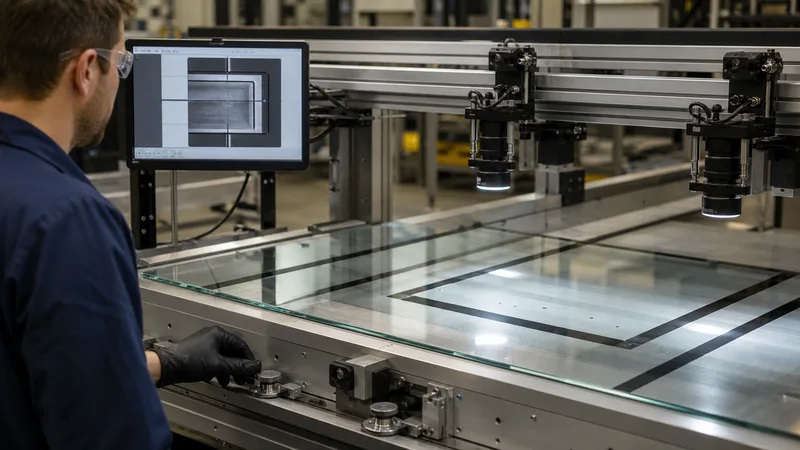
Quick answer: Glass screen printing registration should be defined as a measurable relationship between the print, the glass reference, and the inspection method. Buyers should specify the datum, sample set, environmental conditions, and test duration before comparing supplier claims.
Repeatability is not the same as absolute accuracy, and neither term explains edge-to-print variation by itself. A useful acceptance plan connects machine locating, screen setup, vision or sensors, glass variation, ink behavior, and measurement uncertainty.
Review YISEN’s related equipment category, custom automation service process, and manufacturing overview before requesting a project-specific proposal.
How to define glass screen printing registration
| Decision factor | Buyer question | Evidence to request |
|---|---|---|
| Datum | Which glass edges, holes, marks, or features establish position? | Drawing with datum scheme and tolerances |
| Measurement | What tool, fixture, resolution, and sampling method will be used? | Inspection work instruction |
| Part variation | How will edge, bow, thickness, or feature variation affect locating? | Incoming-part assumptions and sample data |
| Process stability | How are screen tension, squeegee setup, ink, and temperature controlled? | Process setup sheet and controlled test conditions |
| Repeatability test | How many cycles and restarts are included? | Recorded results across a defined run |
| Changeover recovery | How quickly can the first acceptable part be reproduced? | Changeover and first-piece approval record |
A practical procurement process
- Define the print-to-part requirement. Use a drawing that shows the printed feature, reference feature, direction, tolerance, and inspection location. Avoid a single “accuracy” number that is not tied to the part.
- Separate error sources. Review incoming glass variation, locating repeatability, screen preparation, mechanical motion, vision setup, ink spread, and inspection. The acceptance plan should identify which factors the machine can control.
- Run a structured capability trial. Use representative parts and stable process settings. Record the first part, consecutive parts, a restart, and a changeover so the results describe more than one ideal cycle.
- Keep traceable evidence. Save sample identification, setup conditions, measurement method, results, deviations, and corrective actions. The same method should be available for commissioning in the buyer’s plant.
Common purchasing mistakes to avoid
- Mixing machine repeatability with final print tolerance. The finished result includes material, tooling, ink, environment, and measurement effects.
- Testing only one easy panel. A convenient sample may not represent edge quality, coating, size, or flatness variation in production.
- Changing the measurement method after testing. Acceptance disputes often begin when the buyer and supplier use different datums or inspection tools.
Practical buying scenario
For a control-panel glass program, the buyer may need the print aligned to cutouts rather than the outer edge. The RFQ should state that datum relationship and provide samples showing realistic feature variation so the supplier can propose suitable locating and inspection.
Buyer FAQ
What is the difference between accuracy and repeatability?
Accuracy describes closeness to the intended position; repeatability describes how consistently the system returns to a position. Both need a defined datum and measurement method.
Does a vision system guarantee registration?
No. Vision can measure or correct certain variation, but lighting, features, calibration, part presentation, motion, and process stability still matter.
How many parts should be measured?
Choose a sample size that reflects the risk and production pattern. Include consecutive parts, restarts, and relevant changeovers rather than relying on a single print.
Should the buyer provide inspection fixtures?
If the buyer has a required inspection method, share it early. Otherwise, agree on fixtures, gauges, software, and data format before the acceptance test.
Can registration be confirmed without production ink?
A preliminary motion test may use a substitute, but final process acceptance should use the agreed glass, screen, ink, and inspection conditions when practical.
Prepare a useful RFQ
For a registration review, provide the glass type, material and coating, dimensions, datum drawing, application environment, print tolerance, customization needs, expected production mix, packaging requirements, destination country, and project schedule. Confirm all final specifications, compliance responsibilities, commercial terms, and acceptance criteria with the supplier and qualified U.S. specialists.
For a focused glass screen printing registration discussion, submit the project details to YISEN. The technical team can review the confirmed application and propose the next engineering step.