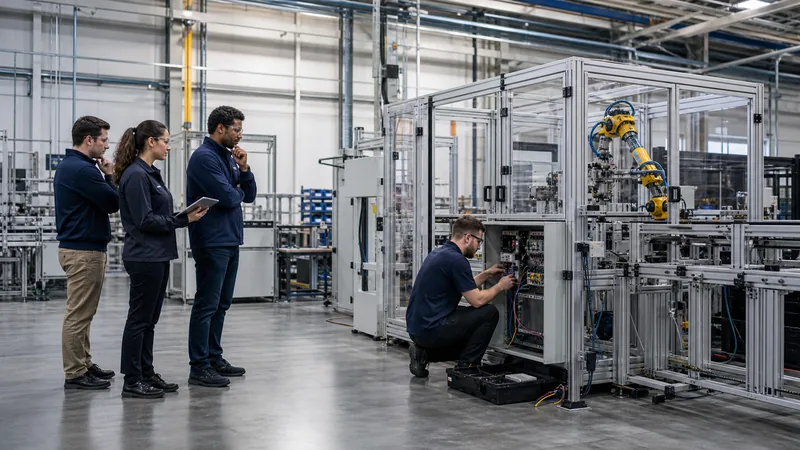
Quick answer: An OEM custom automation project should progress through a controlled sequence: process study, requirement definition, concept review, detailed design, build, software integration, factory testing, installation, commissioning, and handover.
The buyer does not need a finished machine specification on day one, but it should provide reliable product, process, quality, safety, and plant information. Unresolved assumptions should be tracked as project risks with owners and due dates.
Review YISEN’s related equipment category, custom automation service process, and manufacturing overview before requesting a project-specific proposal.
OEM custom automation project gates
| Decision factor | Buyer question | Evidence to request |
|---|---|---|
| Process study | Is the current method understood with real samples and failure modes? | Observed process map and sample review |
| Requirements | Are product range, quality, rate, safety, utilities, data, and interfaces defined? | Approved user requirement specification |
| Concept | Does the proposed sequence address variation and recovery? | Concept layout, cycle model, and risk register |
| Design | Are mechanisms, controls, guarding, access, and documentation reviewed? | Design-review record and action list |
| Testing | Can representative products and fault modes be demonstrated? | FAT protocol and results |
| Handover | Are training, spares, backups, manuals, and acceptance complete? | Deliverables register |
A practical procurement process
- Study the real work. Observe operators, materials, variation, quality checks, rework, stops, cleaning, and maintenance. A process that depends on tacit judgment may need additional sensing or a revised automation boundary.
- Freeze requirements in stages. Approve the design basis first, then close open product samples, interfaces, controls, and acceptance details through formal change control. This prevents informal requests from becoming unpriced scope.
- Review recovery, not only normal operation. Define what happens when a part is missing, misoriented, rejected, broken, or stuck. Include safe manual recovery, restart conditions, and traceability.
- Plan ramp-up and ownership. Commissioning should transfer process knowledge to production and maintenance teams. Agree on staffing, training, trial materials, issue escalation, and final documentation.
Common purchasing mistakes to avoid
- Automating an unstable process. If inputs and quality criteria are not controlled, automation may reproduce variation faster.
- Using a target rate without cycle assumptions. Define product, operator tasks, inspection, changeover, and planned stops behind the rate.
- Leaving sample availability to the end. Late or unrepresentative samples weaken design decisions and acceptance testing.
Practical buying scenario
A packaging manufacturer may want to automate handling between existing operations while keeping a manual inspection step. A phased cell can preserve the judgment task, automate repeatable movement, and create an interface for later expansion if the process data supports it.
Buyer FAQ
What should be included in a user requirement specification?
Include products, process, quality, rate basis, operating modes, safety, controls, data, utilities, environment, interfaces, documentation, testing, training, support, and exclusions.
How are engineering changes controlled?
Use a written change request with technical impact, cost, schedule, risk, and approval before work proceeds.
Who owns the automation concept?
Ownership and intellectual-property terms are contractual. Clarify drawings, software, reusable modules, buyer-specific data, and modification rights before order.
Can commissioning be performed remotely?
Some support can be remote, but installation, safety validation, process trials, and training may require qualified on-site personnel. Define the plan for the actual project.
When is a custom project complete?
Completion should be tied to agreed acceptance evidence, documentation, training, punch-list closure, and commercial terms rather than the machine simply entering production.
Prepare a useful RFQ
For an OEM custom automation review, send the product type, materials, dimensions, application environment, current process, custom functions, estimated production volume and mix, packaging interfaces, destination country, and target commissioning date. Confirm all final specifications, compliance responsibilities, commercial terms, and acceptance criteria with the supplier and qualified U.S. specialists.
For a focused OEM custom automation project discussion, submit the project details to YISEN. The technical team can review the confirmed application and propose the next engineering step.