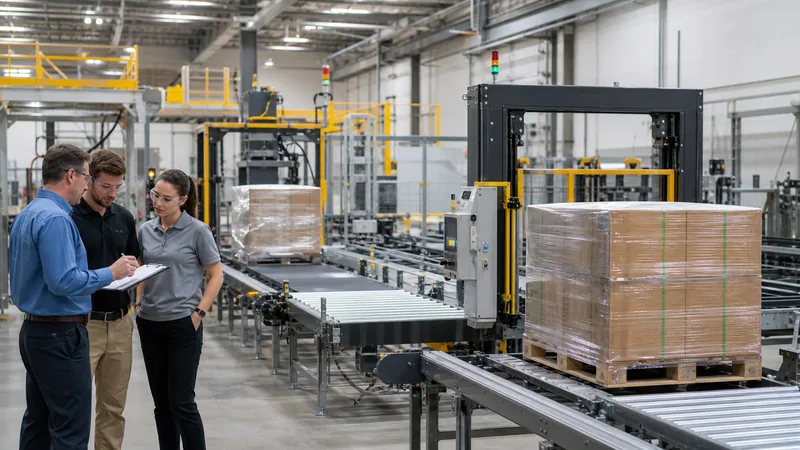
Quick answer: A packaging line factory acceptance test should use representative products and consumables to verify the complete sequence, package quality, safety functions, faults, changeover, interfaces, documentation, and agreed performance basis.
Define the FAT protocol before the line is ready for shipment. If products or packaging materials cannot be supplied, record the resulting limitation and agree on how the missing evidence will be obtained later.
Review YISEN’s related equipment category, custom automation service process, and manufacturing overview before requesting a project-specific proposal.
Packaging line FAT inspection points
| Decision factor | Buyer question | Evidence to request |
|---|---|---|
| Scope | Is every station, option, guard, interface, and spare item present? | Walkdown against contract and drawings |
| Materials | Are approved products and packaging consumables used? | Traceable test lot and specifications |
| Package result | Are protection, seal, wrap, strap, label, and load criteria met? | Inspection record and retained samples |
| Sequence | Are automatic, manual, stop, restart, reject, and recovery modes proven? | Witnessed test protocol |
| Changeover | Can a defined transition be completed safely and correctly? | Timed demonstration and first-good package |
| Documents | Are drawings, backups, manuals, parts, and training materials ready? | Deliverables register |
A practical procurement process
- Freeze test products and materials. Select normal and difficult items plus the actual or approved consumables. Record lot, dimensions, condition, and packaging setup used.
- Test faults deliberately. Create safe simulations for missing product, low consumable, broken film or strap, blocked discharge, absent pallet, sensor fault, emergency stop, and power recovery.
- Inspect the finished package. Use agreed criteria for product damage, wrap or seal, corners, straps, labels, pallet stability, and customer opening. Keep evidence for deviations.
- Close the punch list. Assign every open item an owner, deadline, shipment status, correction, and retest. Confirm updated documents and backups after changes.
Common purchasing mistakes to avoid
- Testing with convenient substitute materials. Different film, strap, carton, pallet, or product friction can change machine behavior.
- Counting cycles but not accepted packages. Throughput should be based on packages that meet the agreed quality criteria.
- Skipping consumable replenishment. Roll, strap, label, or pallet replenishment can affect access, ergonomics, and sustained operation.
Practical buying scenario
For a mixed-product packaging line, the FAT might include a normal run, the largest item, a difficult surface, a consumable change, a product changeover, fault recovery, and finished-package inspection. Site acceptance can then focus on plant interfaces and sustained operation.
Buyer FAQ
Who writes the FAT protocol?
It can be drafted by either party, but buyer and supplier should approve scope, criteria, responsibilities, evidence, and deviation handling before testing.
How many products should be tested?
Use enough parts to prove the agreed objectives and include representative risk cases. The number should be linked to product mix and test purpose.
Should safety testing be included?
Yes. Verify the agreed safety functions and documents during FAT, then repeat relevant validation after installation and integration.
Can a failed item be accepted conditionally?
Only through a documented decision that defines risk, correction, responsibility, timing, retest, and commercial impact.
What data should be retained?
Keep the protocol, sample and material identification, results, measurements, photos, alarms, software versions, deviations, corrections, and approvals.
Prepare a useful RFQ
For a packaging FAT plan, send product types, materials, dimensions and weights, operating environment, package criteria, custom functions, expected quantities and mix, consumables and pallet details, destination country, and shipment target. Confirm all final specifications, compliance responsibilities, commercial terms, and acceptance criteria with the supplier and qualified U.S. specialists.
For a focused packaging line factory acceptance test discussion, submit the project details to YISEN. The technical team can review the confirmed application and propose the next engineering step.