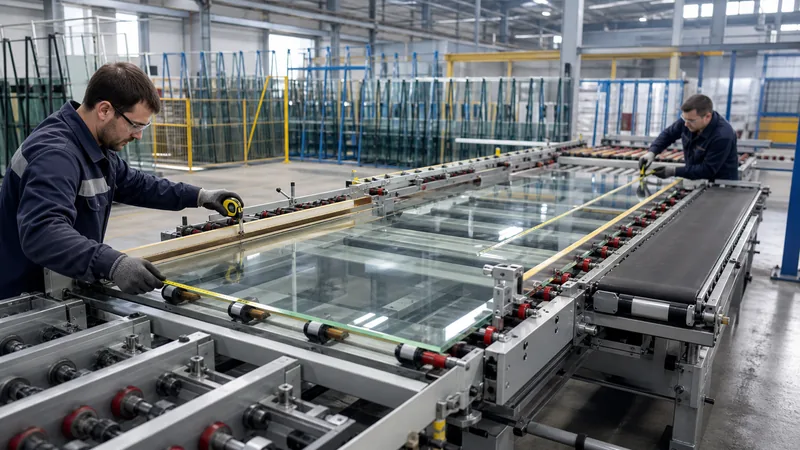
Quick answer: Conveyors for glass and ceramic production lines should be specified from the actual product, allowable contact, orientation, process condition, transfer geometry, accumulation need, contamination risk, and interface logic.
Width, length, and speed do not define a safe or reliable conveyor. Buyers should provide representative products and identify fragile edges, coated faces, hot or wet conditions, alignment needs, and rejected-product handling.
Review YISEN’s related equipment category, custom automation service process, and manufacturing overview before requesting a project-specific proposal.
Conveyor specification for glass and ceramic lines
| Decision factor | Buyer question | Evidence to request |
|---|---|---|
| Product condition | Is the part raw, washed, printed, hot, wet, coated, or finished? | Process-stage contact requirements |
| Support | What roller, belt, pad, or vacuum contact is permitted? | Support-spacing and material review |
| Orientation | Which edge leads and how is rotation or centering controlled? | Material-flow drawing |
| Transfer | How are gaps, elevation changes, corners, and equipment interfaces handled? | Transfer-detail drawings and sample trial |
| Accumulation | Can parts stop or touch, and for how long? | Buffer logic and capacity basis |
| Cleanability | How are debris, ink, water, dust, and broken material removed? | Cleaning and access plan |
A practical procurement process
- Define the complete product envelope. Include minimum and maximum length, width, thickness, weight, bow, edge condition, center of gravity, and surface restrictions. Note which combinations actually occur.
- Map every transfer. Review infeed, outfeed, sensor points, dead zones, guides, stops, lifts, turns, and rejection. Transfers often create more risk than long straight sections.
- Coordinate controls. Define ready, busy, fault, blocked, product-present, recipe, speed reference, reject, and emergency behavior across each interface. Assign ownership for signals and field wiring.
- Test difficult parts and faults. Use thin, small, large, slippery, bowed, fragile, or coated samples as relevant. Simulate stoppage, restart, empty zones, blocked discharge, and removal of a damaged part.
Common purchasing mistakes to avoid
- Using one support spacing for every product. Thin, small, heavy, or bowed parts may need different support and transfer details.
- Adding side guides without a contact review. Guides can scratch surfaces, load fragile edges, or create jams if product variation is ignored.
- Leaving cleaning access behind fixed guards. Routine debris and broken-part removal should be practical and safe.
Practical buying scenario
A glass line may need soft, clean supports before printing and different contact rules after ink application. The conveyor design should follow the changing surface condition rather than use one repeated section everywhere.
Buyer FAQ
Are rollers or belts better for glass?
Either can be suitable depending on contact, support, cleanliness, transfer, speed, and process requirements. Test representative glass.
How is conveyor speed selected?
Coordinate the slowest process, spacing, acceleration, buffer logic, upstream/downstream equipment, and product stability.
Can glass accumulate on the conveyor?
Only if contact, spacing, support, control, and process conditions allow it. Define the accumulation purpose and maximum dwell.
What sensor issues should be considered?
Transparency, reflectivity, size, coatings, background, contamination, mounting, and ambient light can affect detection. Validate on real parts.
What documentation should be delivered?
Request layouts, elevations, loads, contact materials, drives, sensors, controls, wiring, safety information, maintenance, parts, and interface documents.
Prepare a useful RFQ
For a conveyor review, send the glass or ceramic product type, material and surface, dimensions and weight, process environment, contact and orientation requirements, custom interfaces, production mix, packaging or rack details, destination country, and target date. Confirm all final specifications, compliance responsibilities, commercial terms, and acceptance criteria with the supplier and qualified U.S. specialists.
For a focused conveyors for glass and ceramic production lines discussion, submit the project details to YISEN. The technical team can review the confirmed application and propose the next engineering step.